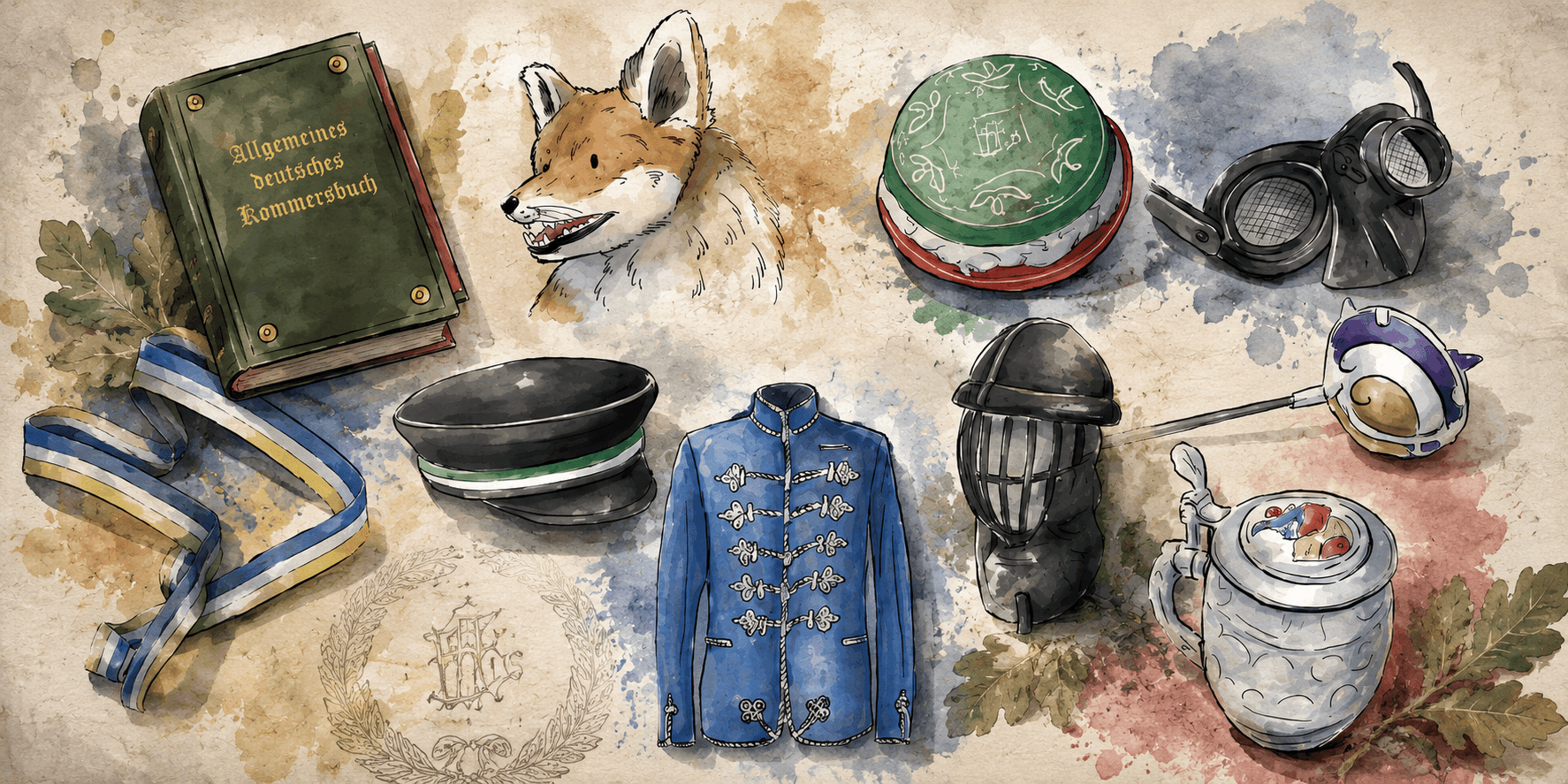
colourful caps and ribbons
Every student fraternity has its own unique character. What Corps share, though, are their principles and a history spanning more than two hundred years — including the colourful caps and ribbons. Around 160 Corps, some of them centuries old, are active at more than 60 universities in Germany, Austria, Belgium, Hungary and Switzerland.
This page explains the principles that have made Corps such successful academic associations over such a long time.
a Corps provides the structure for it
University is a formative phase of life, and joining a Corps enriches it enormously. Experiences such as celebrating together, sport, building friendships or falling in love belong to it just as much as studying together. A Corps provides the organisational structure for that.
Contact, exchange of experience and discussion with people of different generations and from every field of study and profession broaden one's personal horizon. That is why Corps deliberately cultivate traditions that connect members across several generations and build a sense of community.
Corps are also a large network beyond one's own fraternity: being able, as a Corps student, to quickly build a circle of friends with fellow Corps students at other university towns and to meet like-minded people is just one example!
with short distances to travel
Networking is an important personal skill. Membership in a Corps automatically comes with many opportunities for it. Trips and events are organised together with others, so you keep meeting new people. At the same time, Corps events are a place to present and prove your own talents. In the process, social skills and the ability to speak confidently are sharpened almost by themselves — a solid foundation for your later career!
Combined with the short distances within the Corps and the network across Corps, it becomes noticeably easier to find a flat, a good tradesperson, an internship, or perhaps even your next job.
returning after months or years
The Corps does not remain just a memory of your student years — it becomes a lasting part of your path through life, in the form of community, support and a sense of home.
Anyone burdened by family conflict, professional uncertainty, break-ups or personal crises finds Corps brothers in the Corps who are often connected to one another for years or decades. It is precisely this cross-generational closeness that sets it apart from ordinary circles of friends.
The Corps house thereby becomes, for many, a genuine place of retreat — not merely as a building, but as a familiar environment with people who listen, support, and remain present as a matter of course even in difficult times.
Many therefore describe the Corps as a second family of choice. You can return after months or years and still immediately feel familiarity, cohesion and belonging.
This feeling does not arise by chance, but from shared experiences, mutual responsibility, and the willingness to stand up for one another.
fencing is the ticket of admission
Membership and every form of involvement in the Corps is voluntary and unpaid. For the Corps' principles to be lived out, genuine brotherhood and deep trust among Corps brothers are required.
At the start of every membership there is a probationary period before the Corps votes on admitting a new member — but whether someone is all show and no substance often only becomes clear after a longer time.
To filter out from the outset those who mainly want to enrich themselves with the benefits of membership without contributing anything themselves, there is a proven filter: fencing academic duels ("Mensuren"). Fencing is a commitment to the community: "I am willing to stand up for you, and I prove it by fencing — with all the nerves that come with it." It is a powerful bond that connects us across all generations. You could say fencing is the ticket of admission to Corps life.
The mysterious duels are a challenge that, with one's own effort and the support of the Corps, can be mastered even without injuries, and which serves both identity-building and personal development.
the Corps lifestyle
We hold ourselves to a certain standard, and we show it in how we present ourselves, how we treat one another, and how we shape our community. That is why Corps, to this day, cultivate a certain lifestyle that deliberately values standards, reliability and form.
Festive evenings by candlelight, a glass of sparkling wine on arrival, shared meals, dances, communal singing or formal balls — all of this stems from a wish to deliberately set something against an everyday life that has often become dreary and formless.
The Corps lifestyle can also be understood as a countermovement to the laissez-faire everyday life that has become the norm for a large share of today's students.
That is why anyone who wants to belong to this community also lives up to this standard themselves — not just outwardly, but in their actions. They do not see themselves as a passive consumer, but as someone who actively shapes the Corps. You must be able to keep your word in what you say and do, you stand by your commitments, and you take on responsibility.
Many Corps students also share a passion for traditional and demanding leisure activities such as sailing, hunting, golf or riding.
If you would like to learn more about what makes a Corps, feel free to get in touch with us! We can also recommend the following reading:
 Corps Viadrina