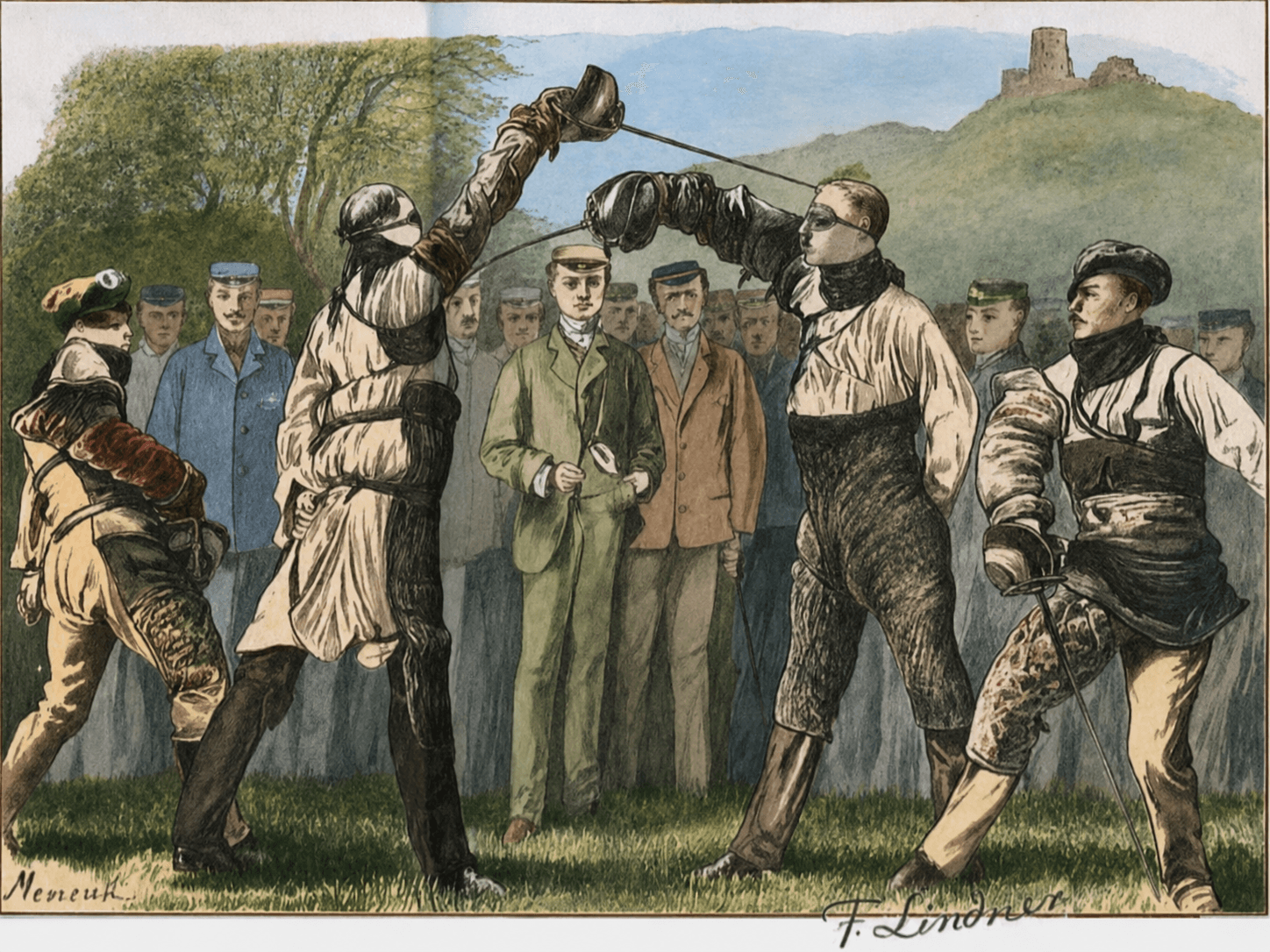
Since quite a few myths surround fencing, we have dedicated a whole page to the topic. Below is an excerpt from the magazine "Die Corps", in which fraternity student Ian Simon gives an interview about fencing.
Ian Simon
Ian Simon was born in the USA in 2002 and went to school in Coburg, where he also became a member of one of the traditional school fraternities. After finishing school, he first studied physics and later switched to Integrated Life Sciences (ILS). In his free time he enjoys playing the piano and tennis.
Interview
On the one hand, it has a long tradition reaching back to the Middle Ages. Back then, students were permitted — because of their long journeys to universities — to carry weapons as the only social group besides nobility and soldiers. Out of necessity, students learned to handle weapons to protect themselves, and disputes were often settled this way. Today, of course, things are different, and even in today's ritualised form it has little to do with back then. We maintain this tradition. But above all, in my view, the academic duel is a commitment to community: I am willing to stand up for you, and I prove it by fencing. It is a powerful bond that connects us across every generation.
I see it above all as a test that one is willing to accept and pass. It shows that you are willing to stand by the community and its values — beyond mere lip service. But of course there are different perspectives, which may even differ slightly from person to person. The Viennese psychiatrist Dr Dr Hans-Otto Thomashoff once said, in an interview with our association's magazine CORPS, that the duel is an experience of extreme self-control, in which you have to control impulses such as flinching or fleeing. That can also help you keep a cool head in other stressful situations.
A major one. Through the duel I stand up for my Corps and my Corps brothers. And, if in doubt, they stand up for me too. In the moment of the duel you stand there alone and fence, but as described above it is actually a team sport that would be unthinkable without your Corps brothers. By the way: somehow the mistaken belief has spread that members of duelling fraternities fence against their own Corps brothers. That is not true. We train among ourselves, but we only fence duels with members of other fraternities.
A Breslau landmark
In the middle of Plac Uniwersytecki, right in front of the main building of the University of Breslau, a bronze figure has stood since 1904 that students still simply call "the Fencer": a young man holding a rapier. The Art Nouveau sculpture was created by Berlin sculptor Hugo Lederer as a symbol of the student code of honour that shaped the university town for decades.
The Fencer's Fountain thus commemorates exactly the tradition that made Breslau one of the most vibrant fraternity cities in Europe: more than a hundred student associations, the Corps foremost among them, cultivated academic fencing here as a lived culture of community — not as a contest against one another, but as a shared experience that bonds people together. Anyone who passes the fountain today stands, quite literally, before a stone witness to this history — a history Corps Viadrina Breslau seeks to carry forward in Wrocław.
 Corps Viadrina