more than a hundred student fraternities
Until 1935, the student fraternity culture in Breslau was among the richest and most diverse anywhere in the German-speaking academic world. At the Silesian Friedrich-Wilhelms University and the Technical University, more than a hundred student fraternities of the most varied kinds existed: Corps, Burschenschaften, Landsmannschaften, Catholic fraternities, gymnastics fraternities, choral fraternities, and Jewish fraternities as well.
Breslau's special position had several causes. The university was founded in 1811 through the merger of the University of Frankfurt an der Oder with Breslau's Leopoldina. This directly carried older student traditions to Breslau. At the same time, Breslau was a cultural border region between Prussia, Silesia and Eastern Europe. The city had a strong Catholic tradition, was at the same time shaped by Protestantism, and was also home to one of the largest Jewish communities. This gave rise to an unusually broad and pluralistic landscape of fraternities.
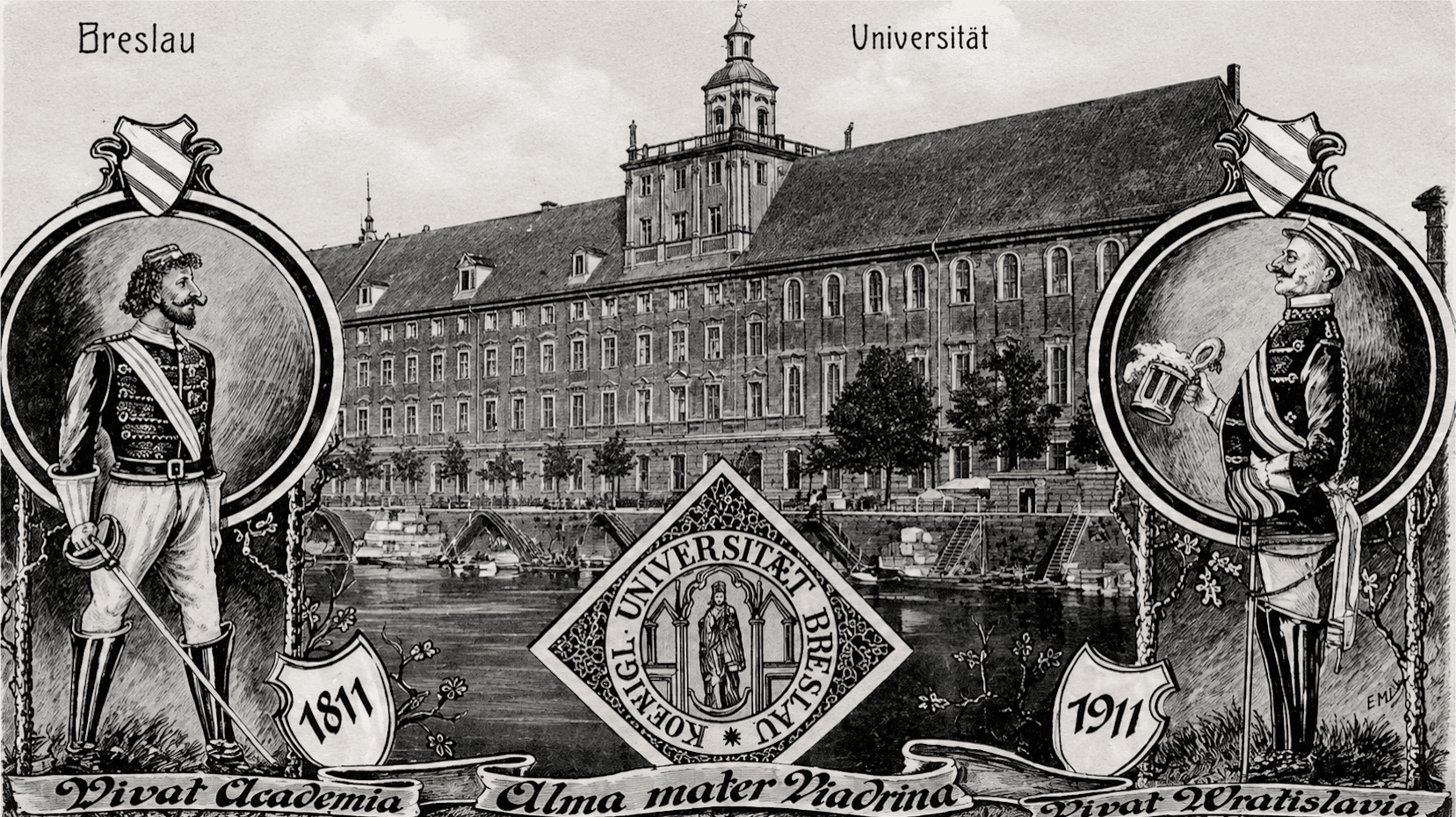
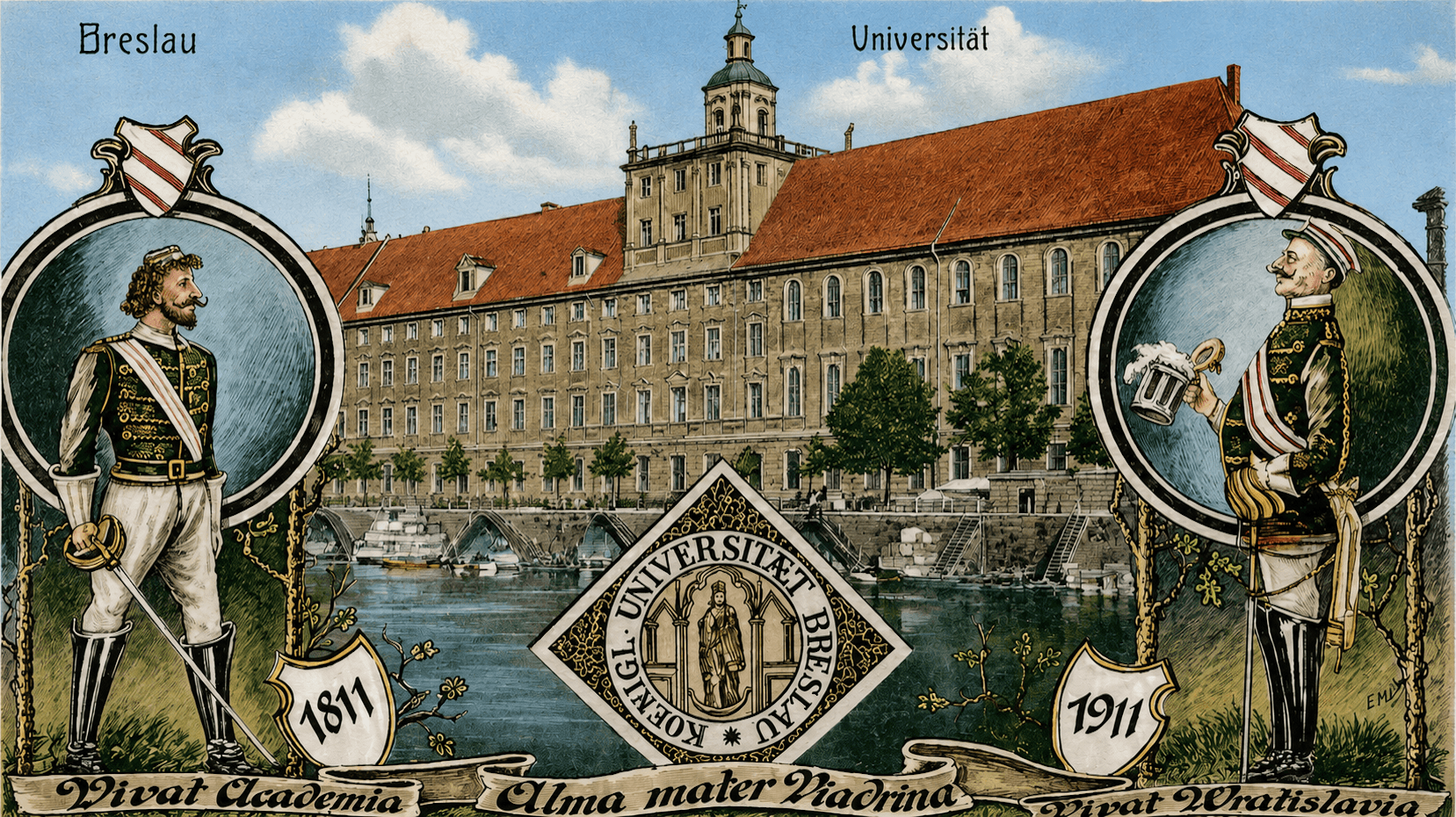
For the university's centenary in 1911, a postcard was even published showing the colours and monograms of every Breslau fraternity — a sign of their high social standing.
Some of these houses still stand today
Among the most important Corps were Corps Borussia Breslau, Corps Silesia Breslau, Corps Lusatia Breslau and Corps Marcomannia Breslau. These Corps were, and remain, part of the Kösener Senioren-Convents-Verband and strongly shaped the university's social life.
Corps and Burschenschaften were far more than mere student leisure clubs. They formed social networks, provided political and social contacts, and significantly influenced Prussia's academic elite. Many professors, judges, civil servants and officers were themselves former fraternity members. The fraternities organised debates, lectures, fencing events, gatherings and formal ceremonies. Corps in particular saw themselves as schools of personal character, discipline and lifelong bonds.
The fraternity culture was also visible in the cityscape. Many fraternities owned their own houses with halls and libraries. Some of these houses still stand today. Academic processions and students in fraternity colours were naturally part of the streetscape of this university city.
Das Abenteuer meiner Jugend
„The first general toast rises — and at once five hundred wild throats strike up the "Gaudeamus".”
The so-called Zobtenkommers played a central role. The Zobten, today Ślęża, became a symbolic point of identification for Breslau's fraternities. At the Zobtenkommers, numerous fraternities gathered each year for a great festive event with flags, fraternity colours, singing and speeches.
This celebration combined student tradition with a sense of Silesian regional identity, since many fraternity members regarded the Zobten as a symbol of the Silesian landscape itself. The gathering was therefore not merely a social event, but an expression of the shared identity of Breslau's students.
The well-known Silesian writer Gerhart Hauptmann once wrote, in his book "Das Abenteuer meiner Jugend" ("The Adventure of My Youth"), about the Zobtenkommers and his particular experiences with Breslau's fraternity students.
„What else could restlessness, the thirst for knowledge, the urge to seek, find and invent be, if not an admission of human imperfection.”
If you would like to learn even more about the history of fraternities in Breslau, or about the subject in general, the following pages are recommended (German-language sources):
 Corps Viadrina